And below is always the accumulated past, which vanishes but does not vanish, which persists and remains (Marilynne Robinson, Housekeeping, Faber & Faber, 1981, 172)

Monday, April 26, 2010

Reconfiguring the wall

(This post has been copied from the 'Blogbook' page of my associated blog, Quilted Out of Space. I had noted these thoughts in a recent addition to this page but they turned out to be posting relevant to this blog)

Reconfiguring the wall sits somewhere between a wall hanging (in the simplest sense--it is intended to hang vertically) and what Emma intends it to be, a quilt documenting and representing her architectural thesis. It certainly has two-sides: on one are the final plans for re-development of the Callan Park site printed on an old linen bed sheet while the other consisted of a 'pieced' (in quilted terms, fragments stitched one to each other) documenting the history of the site...old photographs, street plans, fliers and newspaper articles gleaned form the Mitchell Library (Sydney),as well as stitched and embroidered fragments dyed with plant material from the site.


The two sides, however, are not 'connected' (or perhaps not 'yet') in the physical sense by stitching, a feature any die hard quiltmaker will tell you is fundamental (see most conditions for entering a work to a quilt exhibition) to something being called 'a quilt'.

But Emma intended this to be a quilt (something I argue is central to such a works definition: the artist's intent) and the two sides are most definitely 'connected' in terms of subject matter...the documentary/pieced side is fundamental to the process of developing the final plans for the site...you need to see both sides. It is thus a quilt that must hang in space.

This aspect connects Emma's work to Judy McDermott's, who regularly pieced both sides of her quilts.
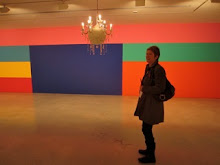
The structure of Reconfiguring is further complicated by having two sections which fold over the side containing the architectural plans for the site, the left hand side contains a list of words, the right alternative arrangements for the rooms (the walls of which can be shifted to allow the internal space to be selected by the individual). The appearance, when the sides are folded over is shown at left (installation shot, Emma Rowden).

While writing this, I sense a link to the folding altars or portable shrines (whether this is at all relevant I'm not sure!).

I now need to return to D&G's theory of smooth space as I have a feeling these points raise some interesting issues for the overall direction of this project.

Wednesday, December 2, 2009

Architecture and the Body

For two years I have been attempting to track down a copy of the catalogue, "Pricked: Extreme Embroidery" (MAD, New York 2008) and finally, today, a copy arrived in the post. The first artist featured is Annet Couwenberg and her work Embroidery Penetrates is described as an architectural intervention: ...an analogy of architecture as a reference point of identity and intentions in the same way as clothing mediates between personal image and social requirements (p12). when I read this, I keep replacing 'clothing' with the word 'cloth', and I think it comes closer to what I am trying to say here.
Only a detail of the work is shown and it appears that the words of the title are stitched in synthetic rope on ultra-light MDF, with the dimensions: 68.6cm x 2.36m--Annet uses text which references 17th Century Dutch samplers--and suddenly the ideology of the feminine (in a 17th C sampler) criss-crosses with the modern (any discussion of this should refer to Rosika Parker's text,'The Subversive Stitch' on samplers, as samplers were not always what they first appeared to be).

There is a link here I think with architecture and Emma's choice of the quilt form to present her honours thesis. The 'reverse' side of this quilt (if it could be called the reverse, perhaps 'other' side is more relevant) pieces (literally and metaphorically) the many narratives associated with the Callan Park site...the many images, documents, plant-dyed with material from the site, embroidered with text and images.
These many narratives are what forms the basis of Emma (architectural) plans printed on linen bed sheets which belonged to Ivo Gertrude Brenan, the great grand daughter of Ryan Brenan who built Garryowen, the first building on the site.
As two sides of the quilt the plans on one side are 'based' on (have an integrity with) the many threads of story on the other side.

Image: The 'other' side of Reconfiguring the Wall prior to the piecing process (courtesy of the artist, 2007).


Wednesday, November 25, 2009

Reconfiguring The Wall


This is the first post of my interconnected blogs which focuses on work by Emma Rowden . With the addition of this blog there are now four that form the basis of my project: 'From the Block to the Blog and Back Again'. In this blog I aim to collect details and thoughts on the process of making a quilt, 'Reconfiguring the Wall' which Emma Rowden made as part of her final year honours architecture presentation in 2006.
Emma chose the former mental asylum of Callan Park (Sydney) as a site to explore: "...the social ethics and politics of architecture" (Emma Rowden, notes from 'Not To Scale', graduation exhibition).
I am hoping so show other work by Emma as well.

Image: Installation view of 'Reconfiguring the Wall' from 'Not To Scale' November 24 2006